
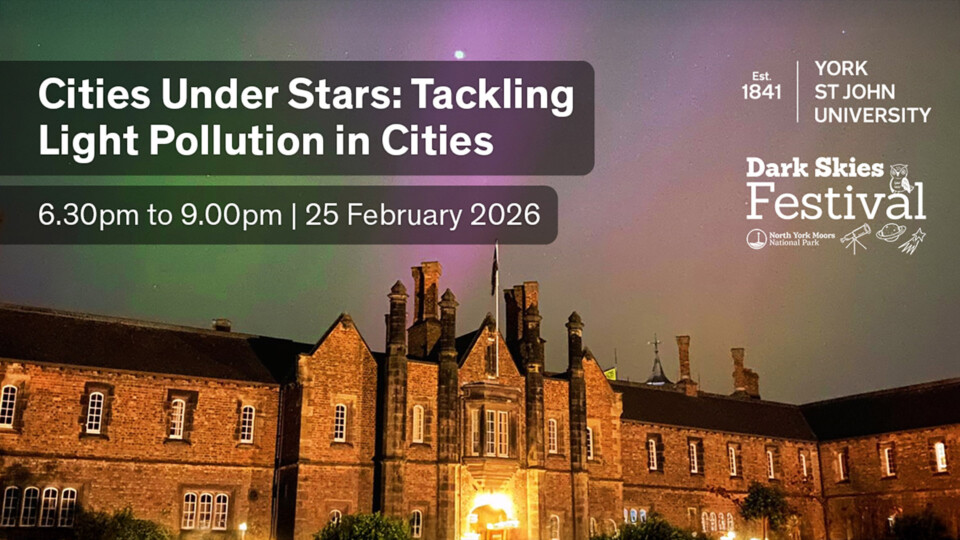
International panel to share expertise on York becoming the UK’s first Dark Sky City
Cities Under Stars: Tackling Light Pollution in Cities offers an evening of discussion, performance, and reflection with leading dark-sky experts, artists, and academics.
Wednesday 25 February
6.30pm to 9.00pm
Creative Centre Auditorium, York St John University
As part of the North York Moors Dark Skies Festival this month, York St John University is hosting an evening of discussion, live performance and practical advice exploring how cities can reduce light pollution, address the climate crisis, and improve environments in both urban and natural settings.
The event, Cities Under Stars: Tackling Light Pollution in Cities, brings together international experts, campaigners, designers and artists to share ideas and real-world experience of protecting the night sky. The panel will explore what it would take for York to lead the way nationally and look at work already underway.
In the past 100 years, access to natural darkness has dramatically declined. Today, only around 10% of people in the western hemisphere experience naturally dark skies, free from artificial light. Light pollution is increasing globally by approximately 10% per year, reducing the number of visible stars and disrupting wildlife, ecosystems and human health.
York St John University has already committed to developing a dark-sky-friendly campus, using existing lighting maintenance and renewal budgets to reduce unnecessary artificial light. The aim is to create a demonstration project for the city, showing how practical changes can make a measurable difference. The Cities Under Stars event will explore how residents, businesses, planners and policymakers can take similar steps.
The evening combines practical advice, creative performance and expert discussion. Chaired by Rachael Jolley, Environment Editor at The Conversation, the panel includes international experts in urban design, tourism, environmental justice, dark-sky conservation and policy development from the UK, Ireland and Canada.
The discussion will explore:
- How cities can reduce artificial light at night
- The balance between safety and sustainability
- The economic and tourism benefits of dark skies
- What York needs to do to become Dark Sky Friendly
Building up to the panel event there will be an immersive electronic dance poetry performance by The Long Dead Stars inspired by walking under the dark skies of the North York Moors and Yorkshire coast.
There will also be a ‘Right Light Roadshow’ – a hands-on demonstration from lighting experts Mike Hawtin and Richard Darn, showing how homes and businesses can improve lighting while reducing glare, waste and skyglow.
Dr Jen Hall, Associate Professor of Cultural Geography at York St John University said: “
“Dark skies are not just for remote national parks they can be part of city life too. As a historic city known for its heritage and beauty, York has the opportunity to become a national leader in responsible, climate-conscious lighting.
“York St John has committed to developing a dark-sky campus and we’re implementing a programme to reduce light pollution using lighting maintenance and renewal budgets. Our goal is to make York St John a demonstration project in the city.
“As well concealing the beauty of starry skies, light pollution has severe consequences for biodiversity, human health and wellbeing.
“There is a growing global movement to ‘protect the night’ from light pollution and with events like this we want to further the dark-sky conservation movement and show how people can get involved.”
Mike Hawtin, Head of Nature Recovery Projects at the North York Moors National Park Authority, said:
“As an International Dark Sky Reserve, the North York Moors National Park is committed to protecting and improving dark skies not only within its boundaries, but far beyond them. Light, like any pollutant, knows no borders. It encroaches from neighbouring houses and businesses, villages and cities, and directly affects our landscapes, wildlife and human health.
“That is why working in partnership beyond the North York Moors is essential. Dark skies are a shared natural resource, vital for nature, culture, health and wellbeing, and they should not be the preserve of remote or protected places. Everyone, in every community has the right to see the stars and to benefit from sensitive, responsible and safe lighting that supports safety, recreation and commerce while reducing needless glare and light pollution.
“By partnering with organisations such as York St John University, the National Park Authority is helping to deliver a first-of-its-kind city-centre project, showing what good lighting looks like in practice and demonstrating how collaboration can protect dark skies for all.”
Book for Cities Under Stars (6.30pm)
Book for The Right Light Roadshow (5pm)
Read more dark skies insights from Dr Jenny Hall in The Conversation Why walking in a national park in the dark prompts people to turn off lights at home