

Cold Hands Syndrome (aka Raynaud’s Disease) – call for more awareness
Raynaud’s – More Than Just Cold Hands
For a condition that affects millions, Raynaud’s barely gets any attention. It doesn’t trend, it doesn’t make headlines, and yet it shapes the daily lives of so many of us, including me. It’s often described as “cold hands” or “poor circulation”, but that barely captures what it’s like to manage it day to day.
Raynaud’s causes the small blood vessels in the fingers and toes to narrow suddenly, usually in response to cold or stress. During an attack, the fingers or toes can turn white, blue, and then red as blood flow stops and returns. It’s painful and unpredictable. It also means people often assume incorrectly that everyday tasks come easy to me. One of my supervisors once decided that our weekly meetings would be “walking meetings” to make the most of the fresh air. I explained that I had Raynaud’s, and he very kindly bought me a pair of gloves as a solution. It was a thoughtful gesture, but anyone with Raynaud’s will know that gloves alone are about as effective as bringing a paper umbrella to a monsoon.

Dr Ria Vaportzis from the University of Bradford. Picture credits: University of Bradford.
The Everyday Effort Behind Simple Tasks
Raynaud’s turns small, routine tasks into things I have to plan around. Opening the fridge, for example, isn’t simple. Touching anything cold with bare hands can trigger an attack, so I use a tea towel as a barrier to take something out. Driving is another challenge. A heated steering wheel isn’t a luxury for me; it’s the difference between being able to drive safely and not being able to drive at all.
Going out takes immense planning, which is why I stay indoors as much as possible. When I do go out, hand warmers become extensions of my hands. If they run out of battery, I spend the rest of the outing worrying, and if an attack does happen, I’m in pain until I can track down something warm like a hot drink, a radiator, the hot counter at Gregg’s, or whatever heat source I can find. Sometimes it doesn’t matter how prepared I am. I can be wrapped up from top to bottom and still get attacks, even indoors, completely at random. Waiting for a bus, walking from A to B, stepping onto a cold floor, passing the chilled aisles at a supermarket, or sitting under an air-con can be enough to trigger symptoms. The rising cost of living has made this even harder: many cafés, workplaces, and leisure spaces are now under‑heated to save on energy, which means I can have an attack in places that should feel warm and safe. It all adds up and shapes how I get through the day.
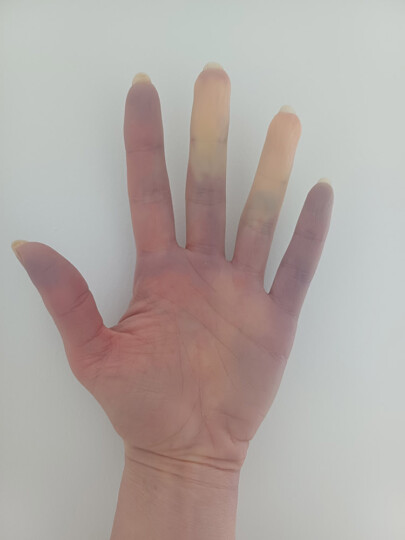
Examples of ‘Cold Hands Syndrome’. Picture credits: University of Bradford.
The Emotional and Mental Load
Raynaud’s isn’t always visibly apparent. As a result, people often don’t understand why I avoid certain situations. When it does become visible, it can lead to some interesting social moments. I once went to pay in a convenience store and the cashier looked at my hands mid-attack and asked, “Why are your hands like that?” I told him I had Raynaud’s, but on the way home I couldn’t help thinking: do people really think it’s acceptable to point out someone’s body like that? Should I have replied with, “Why is your nose like that?”
Comments like “just wear gloves” or “everyone gets cold” make it even harder to explain the reality. Seeking medical advice can be discouraging too. One doctor told me, “You live in the wrong country” and prescribed medication that helps very little. With the NHS under strain, seeing an actual doctor is increasingly difficult; my last appointment ended up being a phone call with a pharmacist.
There’s always a quiet calculation going on in my head: How cold is it outside? Will the venue have heating? How long will I be walking? Will the water, I specifically asked for without ice, magically arrive full of ice anyway? This kind of vigilance becomes second nature, but it’s exhausting.
Why Raynaud’s Needs More Attention
Despite how common Raynaud’s is, it receives very little research attention. Because it rarely leads to hospitalisation, it’s often dismissed as a minor inconvenience and easily overlooked. Recently, I became more active in the Raynaud’s community and carried out a survey with over 700 people including those with primary Raynaud’s (occurring on its own), secondary Raynaud’s (linked to another condition), and people without a formal diagnosis. The findings from the Cold Hands, Warm Heart survey, which explored wellbeing and mental health in Raynaud’s, have now been published. The results reflected the everyday realities reported by people with Raynaud’s: pain and symptom severity have the greatest impact on quality of life, and mental health outcomes are worse than in the general population. People with secondary Raynaud’s, and those without a formal diagnosis, reported the highest levels of stress, anxiety, and depression. Together, the findings highlight the need for tailored support, better screening, and care plans that genuinely reflect the realities of living with Raynaud’s.
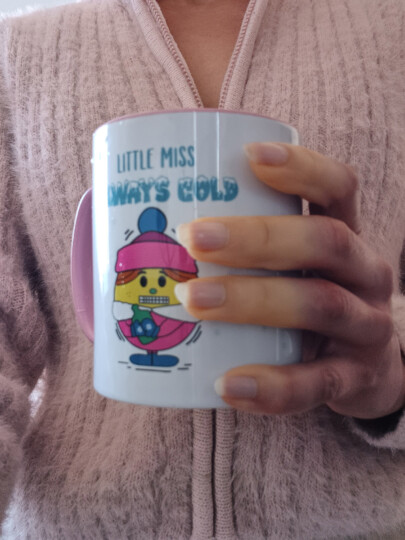
Examples of ‘Cold Hands Syndrome’. Picture credits: University of Bradford.
Moving Forward
There is real potential to improve support for people with Raynaud’s. Even simple changes like better temperature control in workplaces, more awareness and flexibility among employers, and greater public understanding can make a meaningful difference. We also need more research that centres the voices of people living with the condition. For me, writing about Raynaud’s is one small part of that effort. It’s a way of making the invisible visible, and of showing how a condition that rarely makes headlines can still shape someone’s daily life in profound ways.