
Fuel duty regulations
The Cost of War on Transport
As a small business, we pride ourselves on flexibility and stability of service. We know that things can be unpredictable for our customers, and that is exactly why we work hard to be a dependable partner for their transport needs.
That reliability, however, is deeply compromised when the government fails to protect the basic operating conditions that logistics businesses depend on. The fallout from the conflict in the Middle East is being felt across the entire supply chain, but it does not need to be this way. At the time of writing (1 April 2026), since the war began, according to data, diesel prices at UK forecourts have risen more than 28%, from 141.8p per litre to 181p. Even if the conflict was resolved tomorrow, the pain at the pumps will be felt for weeks, or longer, due to the time lag between changes in the barrel price of oil and what the fuel costs at the forecourt. For transport operators, there is no pause button while the market catches up, and government support is conspicuous in its absence, when in fact, it’s needed now more than ever.
The Reality
Fuel constitutes anywhere between 25% and 50% of logistics running costs. Those costs can either be passed on to customers or absorbed by the business. But this is not an isolated pressure. Between rising fuel prices, wage pressures and the broader cost-of-living squeeze, the burden is compounding at every level, from boardrooms to kitchen tables. Whether you are running a household or a company, fuel prices make up a significant part of the budget. Even those who do not drive will be impacted by higher transport costs, as businesses pass on their additional costs to their customers, all of which is adding to the cost-of-living crisis.
The question is not whether businesses can absorb these increases. The question is how much longer they can keep doing so before something breaks.
Food and pharmaceuticals sit at the sharpest end of this. These are not discretionary supply chains, but rather, essential ones. Energy costs are already elevated. Fuel costs are rising sharply on top of that. Every additional cost that cannot be absorbed goes to the bottom line, or to the end consumer via higher shelf prices.
If government members stepped away from ideology and into operational reality, they would see that what is needed is intervention, not platitudes. European counterparts have stepped in to support their transport sectors. The question for UK operators is simple: where is our equivalent support?
What We’re Asking For
I recently wrote to our local MP, Judith Cummins, asking her to put the following to Parliament on behalf of operators like Keep It Cool:
- An immediate reduction in fuel duty, or the introduction of an Essential Fuel User Rebate for commercial vehicles
- A commitment to maintain current fuel duty levels as a minimum, providing stability for essential industries
- The removal of plans to link fuel duty to RPI from April 2027, ensuring long-term business confidence
- Stronger oversight of the fuel market to protect operators from excessive or unfair pricing
- A review of UK energy security and refining capacity to strengthen supply resilience
- The introduction of minimum 30-day payment terms across supply chains to support cash flow
These are not requests for special treatment. They are the basic conditions under which essential supply chains can continue to function.
The Human Cost
Another important consideration here is the wider impact this has on the current cost of living crisis. Government published research shows that in January 2025, 13.9% of households in the UK were ‘food insecure’ (ate less or went a day without eating because they couldn’t access or afford food).
This figure was established before the current fuel crisis accelerated cost pressures across the supply chain. It is not a baseline to hold. It is a warning.
The connection between transport costs and food prices is direct and largely invisible to the people who feel it most. When fuel costs rise, delivery costs rise. When delivery costs rise, the price of food on the shelf rises. The end consumer, often already making difficult choices about what they can afford to eat, absorbs the final impact of a chain of pressures that started long before they reached the supermarket.
In the same report, figures show that in March 2025, 91% of adults who reported an increase in their cost of living said the price of their food shopping had gone up, and 40% had started spending less on essentials, including food. These are not statistics about people in extreme circumstances. They are statistics about ordinary households,
making cuts in ordinary kitchens, because the system that moves food around this country is under sustained financial pressure with no meaningful relief in sight. This Food Foundation article states that since April 2022, the price of a basic weekly food basket has risen by more than 27%. Fuel cost increases layered on top of this do not just affect operators’ bottom lines, they push food further out of reach for the households already closest to the edge.
If the government is serious about food security, about child poverty, about the cost of living, it cannot continue to treat transport as a peripheral concern. The cold chain is not a commercial convenience. It is critical national infrastructure, and the people running it deserve the same level of policy attention as the food it carries.
Why the Government Needs to Act
Transport does not stop when fuel prices rise. Food still needs to move. Medicines still need to reach hospitals and pharmacies. Frozen goods still need to arrive at supermarkets, wholesalers and food businesses across the country. The logistics industry does not have the option to pause operations and wait for the market to settle, and quite honestly, neither do the customers and communities that depend on it.
When transport costs become unsustainable for operators, the consequences do not stay within the industry. They move through the supply chain and inevitably land with the end consumer. Higher fuel costs mean higher delivery costs, which in turn mean higher prices on shelves at a time when household budgets are already stretched.
The requests we have put forward are practical, targeted and proportionate. They are not about protecting profit margins, but in fact, protecting the stability of supply chains that the entire country depends on, and the small businesses that hold those chains together day in, day out.
The response from Judith Cummins came the same day, as she confirmed that she had raised our points directly with both the Chancellor and the Secretary of State for Energy Security and Net Zero. That is exactly the kind of action we need. Now we need it to result in something tangible.
We will keep making the case. We would ask anyone in the industry who feels the same to do the same, because without sustained pressure from operators on the ground, nothing changes, and government action is needed today to ensure essential food and pharmaceutical deliveries continue tomorrow.

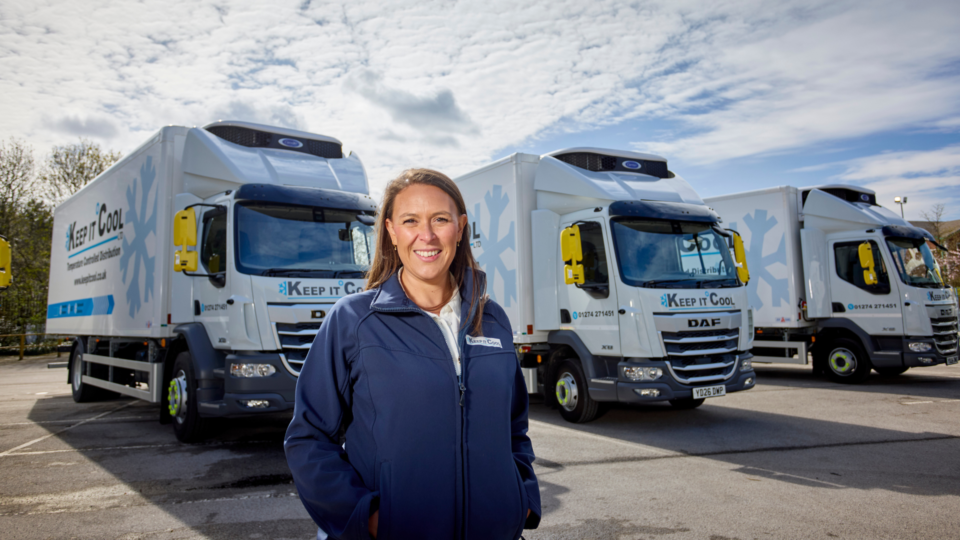
Nikki Redhead, Managing Director, Keep It Cool Ltd
About Keep It Cool
Keep It Cool is a specialist refrigerated transport business serving B2B food businesses across the UK. Operating 24 hours a day, seven days a week, the business provides dedicated same-day temperature-controlled transport with no consolidated loads, no contracts and no compromises.
Founded in 2014 by Managing Director Nikki Redhead, Keep It Cool has grown from a standing start to a £3 million operation, built on reliability, responsiveness and a team that takes responsibility when it matters most.