

How Mollie turned adversity into academic triumph
When Mollie Browes walked across the stage to collect her Master’s degree from the University of Bradford, it marked the start of a future she once thought impossible.
“I’ve been given a second chance by this university,” says the 28-year-old. “They saw potential in me when no one else did. I would not be where I am today without the University of Bradford. That faith changed everything.”
Hard start
Mollie grew up in a world shaped by addiction, instability, and mental health struggles. “It was a hard life but it made me determined and resilient,” she said.
She cites her aunt on her father’s side as influential in shaping her academic ambitions: “I remember not doing very well in science tests for my GCSE mocks but on Sundays for nine months I would walk up to her house and we would study science all day – my grades improved to the point I was getting Bs.”
Her father, Anthony, was brilliant – and in his youth was a talented cricketer – but sadly died aged from an accidental overdose aged just 45 on December 5, 2018. “He always encouraged me and saw potential in me. He was very clever himself, he could have been an academic,” Mollie says. “But life led him down a different path. Losing him was one of the hardest and most defining moments of my life.”
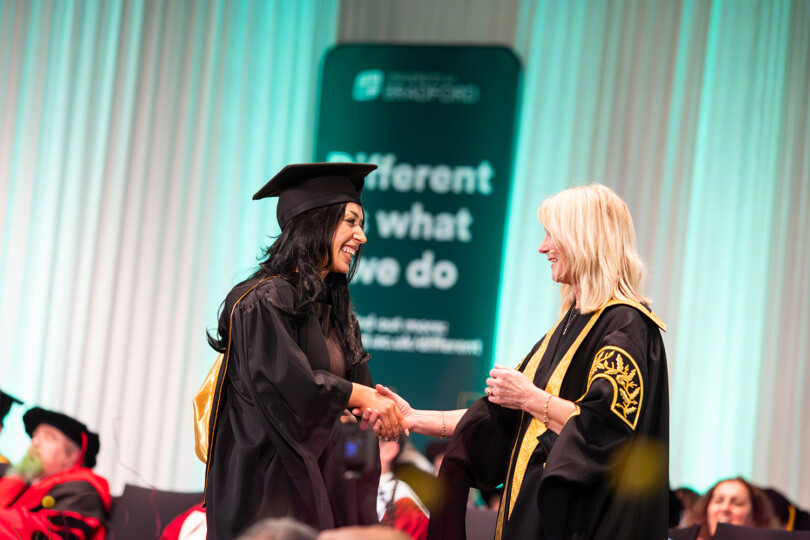
Master’s graduate Mollie Browes, graduating and meeting the Vice-Chancellor Professor Shirley Congdon. Picture credits: University of Bradford
Second chances
Originally enrolled on Applied Sciences in 2015, Mollie suspended her studies due to mental health issues. When she returned in 2018, the university offered her the chance to transfer into Biomedical Sciences. It was the break she needed but the death of her father in her first semester led to her pausing her studies again.
More obstacles followed. COVID hit and when she realised she needed to protect her grandparents (with whom she was living at the time), she left home and found herself without anywhere to stay. Coupled with ongoing mental health issues, Mollie experienced homelessness more than once. But she refused to give up.
Then, in 2021, during Freshers’ Week, she was the subject of a violent attack which left her with a broken leg and spent weeks in hospital and months in recovery.
She admits there were personal challenges that threatened to derail her ambitions throughout her bachelor’s degree. “It hasn’t been easy for me, and part of that is down to being raised in a difficult environment. But I always knew I wanted a different life and I’m grateful to the University for supporting me and helping me get where I am today. That phase of my life is behind me now, and I’m positive about the future.”
Turning point
Support from the University of Bradford proved life changing. Diagnosed with severe combined-type ADHD and later complex PTSD, Mollie accessed counselling, disability services, and mental health support. “My mental health advisor, Kathryn Holdsworth, changed my life,” she says. “She even came to community mental health appointments with me. She is still supporting me now, even though I have technically left.”
Mollie also benefited from the Turing Scheme, working abroad at Centre of Biology Sousse, Morocco and the Centre of Genetics Rabat, Morocco.
Academically, everything clicked in her final year. “Something just changed in me,” she recalls. “I went from scraping through and getting 30 and 40 percent to hitting 80 percent. She graduated with a 2.1 in BSc in Biomedical Science, earned a first-class dissertation entitled ‘Expression profiling genes involved in vitamin D and integrin signalling pathways’ and won the Terry Baker Prize for overcoming adversity and secured joint first place for her research poster.
Mastering the next challenge
Mollie wasn’t planning a Master’s until the University’s Institute of Cancer Therapeutics invited her to apply. “I walked into the labs and fell in love,” she says. She completed her Master of Research in Drug Development in just 12 months (rather than the usual 24), mastering advanced techniques in medicinal chemistry, LC-MS, and peptide synthesis.
“I learned how to think like a scientist, independently, critically, creatively. I absolutely love it, it has really brought joy to my life but it’s still sometimes feels strange to me to think I’ve got to the level where I’m writing first class research papers on cancer drugs.”
Her most recent 16,000-word dissertation – for which she also received a first – is called ‘Development of activatable fluorescent probes for functional activity imaging of MMP-14’, in which she discusses such things as ‘cleavable peptides linked to a dye/quencher pairs’, ‘the efficacy of platinum compounds and taxanes’ and ‘tumour invasion and angiogenesis.’
Her work at the Institute of Cancer Therapeutics explored how these “activatable” probes could provide real-time imaging of cancer’s most aggressive processes, helping clinicians distinguish tumour tissue from healthy tissue during surgery and monitor treatment response – her findings could pave the way for safer, more precise cancer therapies and diagnostics.
Looking ahead
Now, Mollie is interviewing for industry roles to strengthen her technical expertise, with a long-term ambition to become an independent cancer researcher. “I want to contribute to understanding and treating cancer at the molecular level,” she says. She’s currently looking for jobs in practical medicinal chemistry, analytic chemistry and bio-analysis.
Her message to others? “What I’d say to anyone who finds themselves in a place they don’t want to be or from which they think they can’t get out of is don’t let anyone dictate what you can or cannot handle. Accept help that’s available – places like the University of Bradford really do make a difference in this way. Believe in yourself even when nobody else can see it – keep trying and someone else will eventually see it too.”
Her graduation day was two days before the anniversary of her father’s death. “I know he’d be proud,” she added.
Goreti Ribeiro Morais, Lecturer in Medicinal Chemistry, said: “Her attitude is a great example of how resilience, positivity and commitment to a better future can serve as a role model for underprivileged students.”
Ethan Perkins, the Institute of Cancer Therapeutics PGT Lead and Mollie’s Personal Academic Tutor, said: “Everyone has their own challenges but Mollie has undertaken much more than her fair share, demonstrating along the way just how resilient we can be when we decide nothing is going to stop us achieving our dreams.”
And finally…
Anyone looking for a Master’s graduate who knows the difference between Förster resonance energy transfer and a quenched pro-probe logic for activity-based imaging, Mollie is on the lookout for work, particularly in scientific writing. Contact press@bradford.ac.uk.