
Over £1 million awarded to boost young people’s mental health through creative writing and ethical AI
York St John University partners with Goldsmiths and University of Leeds for Creative Writing Together project
A major new research project led by York St John University has secured over £1 million in funding to support young people’s mental health, strengthen family relationships and promote inclusion through creative writing.
The three-year project, Creative Writing Together, is funded by the Arts and Humanities Research Council (AHRC) and delivered in partnership with Goldsmiths, University of London and the University of Leeds. It will run from May 2026 to April 2029 in communities across York and London.
The funding of just less than £1.02 million is the largestAHRC Standard Research Grant for a project solely focused on Creative Writing.
The UK is facing a significant mental health challenge affecting both children and their parents, particularly in areas of social disadvantage. Schools are on the front line of this crisis: in 2025, the Department for Education reported record levels of ‘severely absent’ pupils, with many suffering from emotional-based school avoidance.
While the causes are complex, there is widespread agreement, including from the World Health Organisation (WHO) and the Education Endowment Foundation (EEF), that responses should focus on holistic approaches that go beyond traditional therapy. They suggest concentrating instead on strengthening relationships between families, schools, and communities.
Creative Writing Together introduces a new approach to tackling this challenge by developing Reflective Functioning (RF) — the ability to understand one’s own and others’ behaviours in terms of underlying thoughts, feelings, and intentions — through collaborative creative writing. RF is closely linked to improved relationships, emotional wellbeing, and resilience.
Uniquely, the project brings together children, parents, and teachers as co-writers in a series of workshops and online experiences designed to foster empathy, perspective-taking, and imaginative play. Co-developed with teachers, writers, and wellbeing experts, the workshops will be delivered in schools and community settings, including pupil referral units, with a focus on areas facing social disadvantage. Each programme will run for eight weeks and be led by experienced writers and teachers.
Another distinctive feature of the project is its use of generative artificial intelligence (AI). Rather than replacing human creativity, AI will be used as a tool to spark ideas, support writing and encourage critical thinking. Instead of relying on large, commercial language models trained on vast amounts of unconsented creative work, the team will work with an AI expert to develop a more ethical and bespoke system.
Participants will experiment with co-writing stories, exploring different viewpoints, and comparing human and AI-generated responses to help them reflect more deeply on perspective and communication.
Early pilot sessions have already shown promising results.
Penny, who attended a workshop with her son Rory, said it was a very positive experience:
“I thought it sounded like a great thing to do with my son. I enjoy writing and wanted to encourage him to explore this more too. I liked the idea of spending time with him doing something creative together and he was enthusiastic about it too which was great.
“We checked in at various points to see where the stories were going and I was really surprised that the stories were very similar, but from different perspectives. A lot of our language and approach was also really aligned. It was interesting in terms of understanding a bit more about my son’s perspective but was also a really fun, enjoyable and creative way to spend a few hours together.
“It helped to focus creatively on something outside of our usual family discussions, taking us out of the ‘now’ helped us to connect in a different, and very productive, way. It helped me to understand his position better, and for us to talk about how we approach different scenarios.”
Rory added:
“It was pretty cool… I enjoyed being able to choose what we were writing about and creating the story, it was fun.”
Professor Tom Dobson, Professor of Education at York St John University and Principal Investigator, said:
“This is a moment in time when the divide between the generations is greater than ever. That’s why I’m so excited to be leading this vitally important research project. Our pilot studies have shown that adults and children writing creatively to explore their own and each other’s point of view, including critically reflecting upon how AI simulates human points of view, can help bridge this divide.
“Through our project, we hope to show how creative writing can have profoundly positive impacts, both in terms of children’s mental health and positive relationships with parents and teachers. As a father of two daughters, I know how much this project would have been of benefit to my family!”
Dr Francis Gilbert, Senior Lecturer in Educational Studies at Goldsmiths, said:
“Creative writing gives people a powerful way to reflect on their experiences and relationships. Our hypothesis is that when people write together across generations, they develop reflective functioning, the ability to understand their own feelings and those of others. That capacity is strongly linked to wellbeing and healthy relationships.
“Creative writing is in a rarefied space at the moment. A lot of people feel they can’t write creatively. This research is about getting it out of the academy and exams and showing how it can be a powerful tool for everyone.”
Dr Paige Davis, Lecturer in Developmental Psychology at the University of Leeds, said:
“Stepping outside our own perspective to understand other people’s point of view helps us to empathise, communicate and resolve conflict. Within this project, it will allow parents, teachers, and young people to connect and help these groups understand each other more deeply. Using writing to become closer to others and explore their own internal lives could not only help these groups now, but also have a ripple effect into their future relationships.”
The research team is now inviting schools, community groups, parents, carers, and teachers to take part in the free programme.
Following on from the workshops the project will deliver:
- A practical guide for teachers and parents
- A collection of co-created writing from participants
- A framework for using AI in creative and educational settings
- 8 academic research publications
To discuss the York programme, please contact Professor Tom Dobson: t.dobson@yorksj.ac.uk
To discuss the London programme, please contact Dr Francis Gilbert: f.gilbert@gold.ac.uk
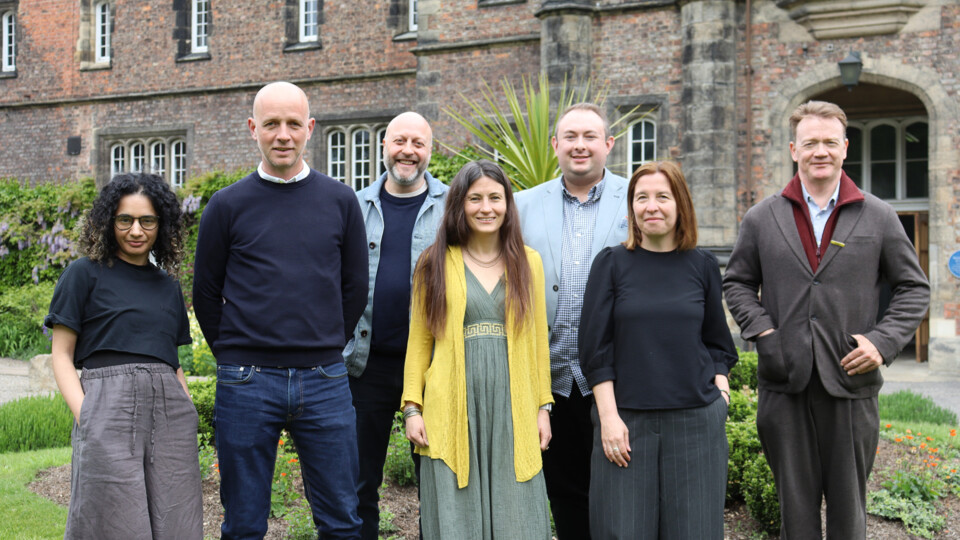
Image caption: (l-r) Samia Rahman, Tom Dobson, Daniel Ingram-Brown, Paige Davis, Sam Clarke, Jane Collins, Francis Gilbert. Credit: York St John University