
The quiet power of surplus
Every year, tonnes of perfectly good food is classed as surplus before it ever reaches a supermarket shelf. The reasons for this are numerous: from overproduction to packaging changes, missed deliveries, and even batch variations.
Company Shop Group, based in Barnsley, is one of the businesses doing something about it. They rescue surplus food from across the manufacturing and retail chain and redistribute it through their network of 13 ‘Surplus Supermarkets’ across the UK. Their social enterprise, Community Shop, takes it a step further, operating as a not-for-profit social supermarket with 17 stores that give access to deeply discounted food, alongside personal development programmes, to support communities in need.
Why this matters to the cold chain
For those of us working in temperature-controlled logistics, surplus food is part of the daily reality. We’re naturally embedded in every part of the chain, from manufacturer to retailer. We know how easily a perfectly good product can end up classed as surplus through nobody’s fault, simply because the system has narrow tolerances and tight schedules. We also know the pressure that puts on producers, who absorb the cost when product gets rejected, downgraded or delisted at short notice.
What organisations like Company Shop Group do is give that product a route to people, not to waste. For producers, that means recovering value that would otherwise be lost. For families, it means access to quality food at prices that make a meaningful difference. For the wider supply chain, it means less waste, more food security and a stronger argument for tackling the inefficiencies that create surplus in the first place.
Food, community and the case for working together
The food industry talks a lot about sustainability targets, carbon emissions and net zero commitments. And they all matter, but food waste is one of the most immediate, practical and addressable problems we have, and it sits at the intersection of sustainability, food security and community welfare.
WRAP figures state that, globally, at least 1.3 billion metric tons of food is wasted each year. Meanwhile, food insecurity continues to climb. The disconnect between those two realities is one that surplus redistribution helps to close, and the more the industry engages with it, the more meaningful the impact becomes.
Our work with Company Shop Group
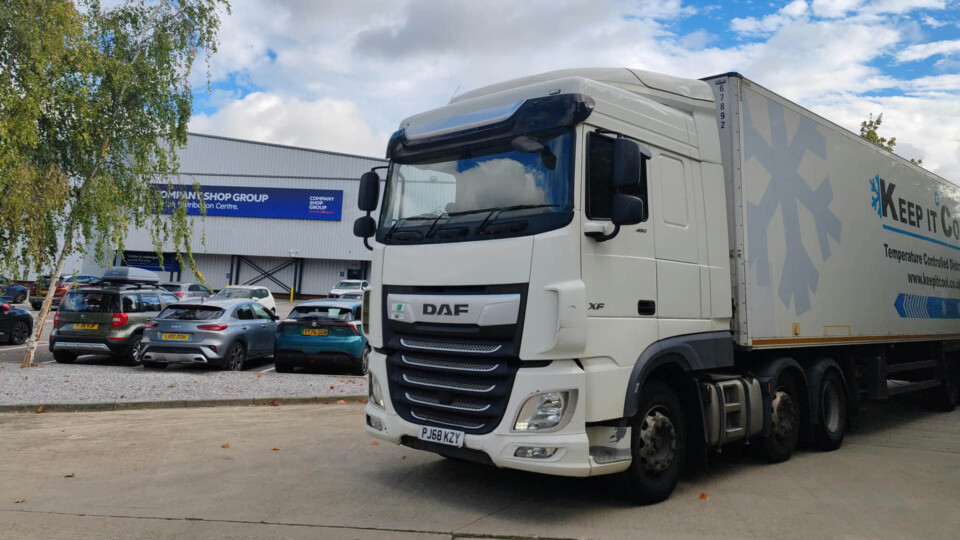
Company Shop Group operates under our Flex Support Service. We step in to move surplus and frozen product across their network as and when required.
Flex Support is designed to provide capacity that scales with demand, without either side being tied into a contract that does not reflect the reality of surplus food. Some weeks we move more than other weeks, but the standard of service and support always remains consistent.
We understand that a delayed or mishandled delivery of surplus food does not just cause an operational problem, but it also risks the food not reaching people who need most it in good condition and on time.
The feedback we have received reflects the standard we hold ourselves to on every job:
“Keep It Cool have added outstanding value to our transport operations.”
“Keep It Cool appear to be really impressing across the team in regard to the frozen movements and arriving on time to the collections, so I’d be looking at using them for next week’s movements.”
Working together better
The more I look at what businesses like Company Shop Group are doing, the more I think the answer to many of our industry’s biggest challenges is not new technology or new policy. It is better collaboration. Producers, retailers, redistributors, logistics operators, and the communities that benefit from all of it, working together more intentionally and more visibly.
Surplus food is one example, but there are others; the point is that the food industry does its best work when it stops thinking of itself as a chain of separate businesses and starts thinking of itself as a shared system. The people standing in Company Shop Group’s ‘Surplus Supermarkets’ and its Community Shop’s every week are not statistics. They are families, and the work that gets them there matters.
We are proud to be a small part of it. And we are keen to do more.