
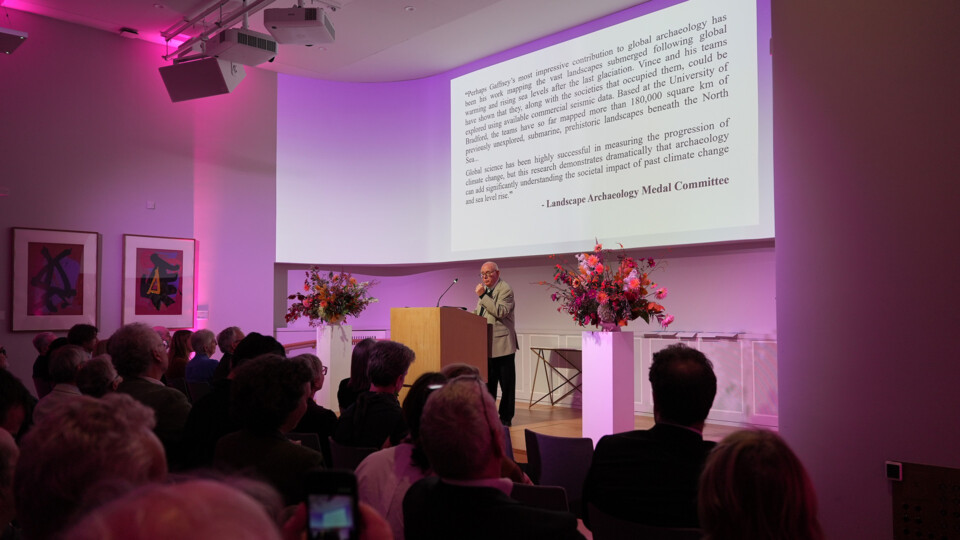
Bradford archaeologist honoured for mapping ‘lost world’ beneath the North Sea
A University of Bradford archaeologist whose pioneering research has transformed our understanding of landscapes lost to rising sea levels since the last Ice Age has received one of the discipline’s highest honours.
Professor Vincent Gaffney, the University’s 50th Anniversary Chair in Landscape Archaeology, has been awarded the prestigious British Academy Landscape Archaeology Medal 2026 in recognition of a career that has helped reshape how archaeologists understand and investigate ancient landscapes.
The award recognises work spanning more than four decades and highlights Professor Gaffney’s internationally recognised contribution to digital archaeology.
Most notably, he and his colleagues have mapped more than 180,000 square kilometres of submerged prehistoric landscapes beneath the North Sea, helping reveal a vast, lost world that once connected Britain to mainland Europe before rising sea levels transformed the region.
Deeply honoured
Commenting on the award, Professor Gaffney said: “I am deeply privileged to receive the British Academy Landscape Archaeology Medal. While this award recognises a personal journey, it also reflects the achievements of the many talented colleagues, researchers and students I have worked alongside over the years.
“Archaeology is no longer simply about digging. Today, we use some of the world’s most advanced technologies to understand landscapes and societies in ways previous generations could never have imagined, from large-scale digital mapping and geophysics to remote sensing, artificial intelligence and advanced visualisation.
“The work undertaken at Bradford has shown how these technologies can help us rediscover the lost worlds beneath our seas, understand the consequences of past climate change and bring archaeology into conversations about some of the biggest challenges facing society today.
“I’m particularly proud that so much of this work has taken place at Bradford, where archaeology, digital innovation and interdisciplinary collaboration have gone hand in hand for many years.”
Awarding the 2026 British Academy Prizes and Medals, Professor Susan J Smith, President of the British Academy, said: “Congratulations to this year’s recipients of the British Academy prizes and medals. Their work exemplifies the rigour, expertise, creativity and intellectual ambition that define the humanities and social sciences. Across an extraordinary range of disciplines, these scholars are expanding the boundaries of knowledge, offering fresh perspectives on the questions of our time, past present and future. The British Academy is proud to recognise their achievements and the lasting contribution they make to the way we understand and change the world.”
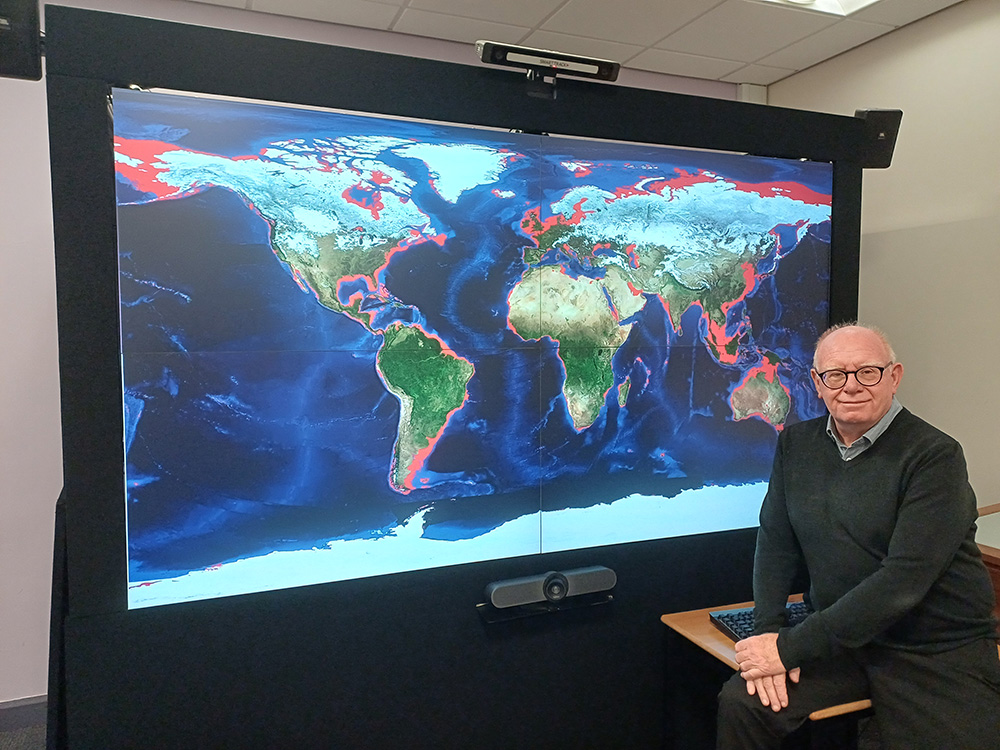
Professor Vince Gaffney next to a map showing Doggerland, the sunken land mass that used to connect Britain and Europe during the last ice age. Credit: University of Bradford.
Digital technology
Based at the University’s Submerged Landscapes Research Centre, Professor Gaffney’s work has pioneered the use of advanced digital technologies to investigate the past, leading to major international collaborations across the Mediterranean, the Americas and South-East Asia.
The British Academy’s citation praised Professor Gaffney’s role in pioneering new technologies to visualise the past and applying those same technologies to demonstrate archaeology’s relevance to contemporary challenges, including climate change and the impact of environmental transformation.
Professor Gaffney joined the University of Bradford in 2014 and established the Submerged Landscapes Research Centre, which has become a global leader in the investigation of inundated prehistoric landscapes and the study of how past environmental change shaped human societies.
Professor Sherif El-Khamisy, Pro-Vice-Chancellor for Research, Innovation and Global Engagement, said: “Professor Gaffney’s work has transformed our understanding of the past by combining archaeological expertise with cutting-edge digital technologies. His research shows how innovation can unlock new knowledge, helping us better understand both ancient landscapes and some of the most pressing challenges facing society today, including environmental change and sustainability.
“His achievements reflect the University’s commitment to research that pushes boundaries, generates international impact and helps shape conversations far beyond academia.”
The British Academy medal was presented during a special ceremony at the Royal Academy in London on Thursday 15 October.
The citation reads:
Professor Vincent Gaffney’s distinguished career in world archaeology has been recognised both nationally and internationally over decades. As a renowned landscape researcher specialising in digital archaeology his career has been driven by a desire to pioneer the use of new technologies to visualise the past but also to use these same technologies to explain the relevance of archaeology in the present. Perhaps his most impressive contribution to global archaeology has been his work mapping the vast landscapes submerged following global warming and rising sea levels after the last glaciation. Based at the University of Bradford, the teams have so far mapped more than 180,000 square km. of previously unexplored, submarine, prehistoric landscapes beneath the North Sea. Vince’s establishment of the dedicated Submerged Landscape Centre at Bradford has now led to collaborations with colleagues in the Mediterranean, the Americas and in south-east Asia. His research in the North Sea and his associated projects are unique. Rewarded in 2013 with the European Archaeological Heritage Prize and in 2018 with an MBE, the scope and impact of his work and his engagement with the wider public continue and will help determine how British archaeology will be viewed in the future and how the discipline will develop across the next generation. We believe he is an outstanding candidate for the award of this medal.
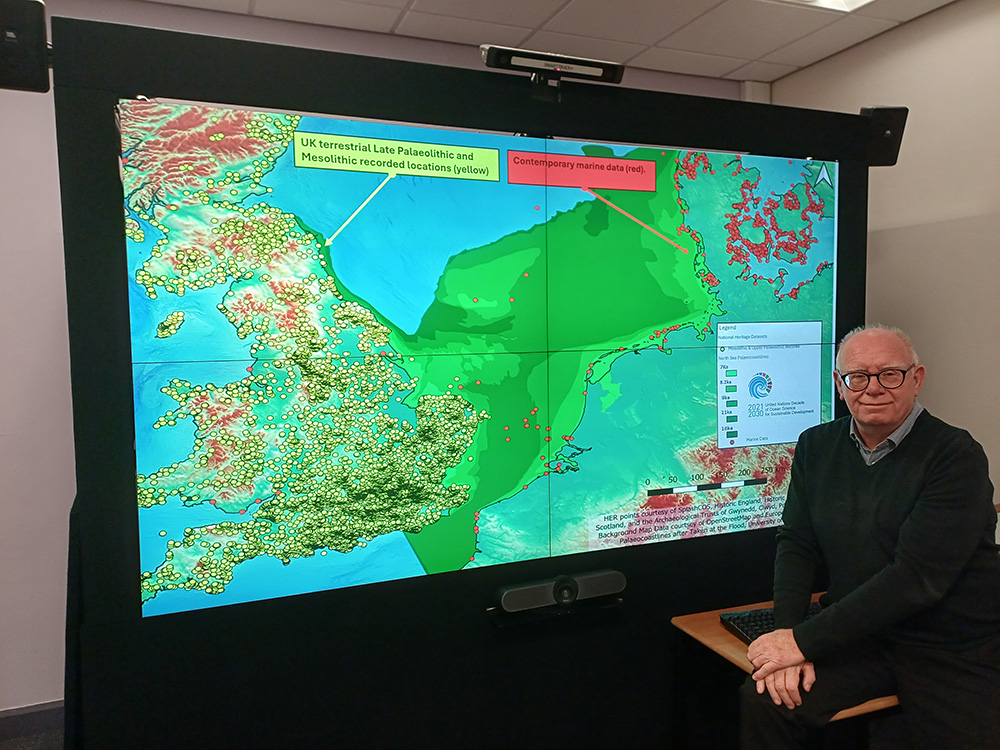
Professor Gaffney, who has received the prestigious British Academy Landscape Archaeology Medal 2026, next to a world map showing coastal areas affected by sea level rise at the end of the last ice age, many of which are now the subject of underwater archaeological surveys. Credit: University of Bradford.
Professor Gaffney – a potted history
Professor Vincent Gaffney is the 50th Anniversary Chair in Landscape Archaeology at the University of Bradford. He studied archaeology at the University of Reading, and his first foray into landscape research involved the study of Roman settlement on the Berkshire Downs.
Following a period in museums, he undertook postgraduate research in former Yugoslavia. Based in Ljubljana, his study area was the island of Hvar (Croatia) and, following a placement with the Arkansas Archaeological Survey, he co-published an early GIS-based landscape study using data from Dalmatia.
After graduation from the University of Reading, he worked in the Birmingham University Field Archaeology Unit. Working with an international team, his research in Croatia continued and expanded across the Central Dalmatian islands.
In Britain he led a Leverhulme project surveying the urbs and hinterland of the Roman town at Wroxeter. He also founded the Visual and Spatial Technology Centre (VISTA), to support large-scale, digital heritage projects.
Employed as a part-time lecturer at Birmingham, he later became Director of the Institute of Archaeology and Antiquity, and then Director of Research and Knowledge Transfer for the College of Arts, Humanities and Law at Birmingham.
Although continuing to undertake research in Europe, Africa and the Americas, Professor Gaffney worked with the Ludwig Boltzmann Institute on the Stonehenge Hidden Landscapes Project. This project applied extensive multi-technique surveys across the world heritage landscape. Teams led by Professor Gaffney also carried out a series of studies exploring the habitable landscapes lost to the sea following postglacial, global warming and rising sea levels.
Professor Gaffney moved to Bradford in 2014 and established the Submerged Landscapes Research Centre, to champion research into inundated prehistoric landscapes, and to disseminate the implications of past climate change to contemporary society.
Image caption (top of page): Professor Gaffney delivering his acceptance speech at the British Academy. Credit: the British Academy.