
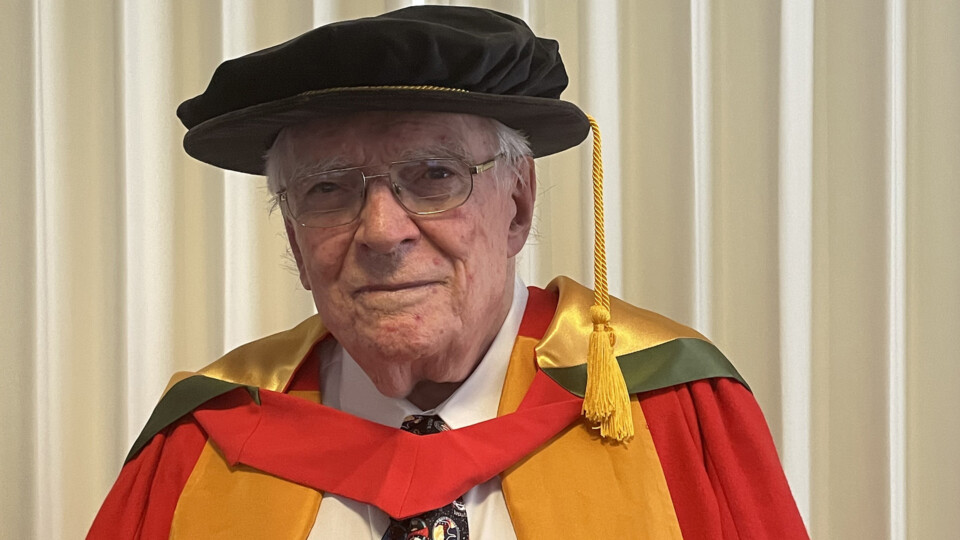
Moon signal man honoured by university
Born in Bradford in 1933, Michael John Dinn’s career helped shape one of the most iconic moments in human history – Neil Armstrong’s first steps on the Moon. Now at 92 (he will turn 93 in April), he has been awarded an Honorary Doctorate of Engineering from the University of Bradford in recognition of his distinguished contributions to deep space tracking and exploration.
After earning a degree in electronics from London University, Mike worked on aircraft systems before emigrating to Australia in 1960. There, he joined the Royal Australian Air Force’s Aircraft Research and Development Unit, a move that would eventually place him at the heart of NASA’s Apollo programme.
Commenting on his honorary degree, Mike said: “After 65 years away from Bradford, I was very surprised and excited to be awarded this Honorary degree. I value it as a recognition of my very satisfying career in engineering, founded on the degree I got in 1955 after four years study at Bradford Tech (which evolved into the University).
“I was born and bred in Bradford, as were my wife and first two children. The degree gave me a great start to my engineering career, primarily in ‘space’. At that time the word only meant the gap between words. Now I see that the University has a very large section devoted to this. So, a space engineering career will have a great future.”
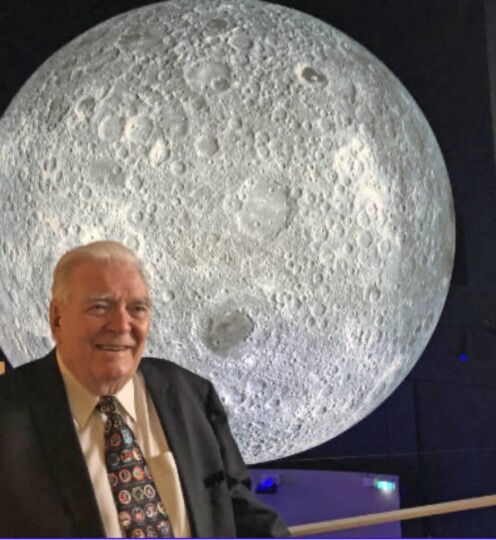
Mike Dinn generic. Images c/o Mike Dinn
No TVs
“I still have many relatives and friends in Bradford today, with some planning to represent me at my graduation. So, I thank the University for the award and the opportunity for the family to take part.
“I have many fond memories of growing up in Bradford in the 40s and 50s and attending primary, secondary (St Bede’s) and tertiary education there. I have some memories from just before and during the Second World War, when we were evacuated from St Joseph’s primary to Silsden for a few months at the start of war. I also remember some bombs falling on Bradford, in particular the middle of St Peter’s, Leeds Road.
“Bradford life revolved around public transport and social life was church and school and College dances, and the cinema. No TV in those early days, but I remember it coming in the early 50s.
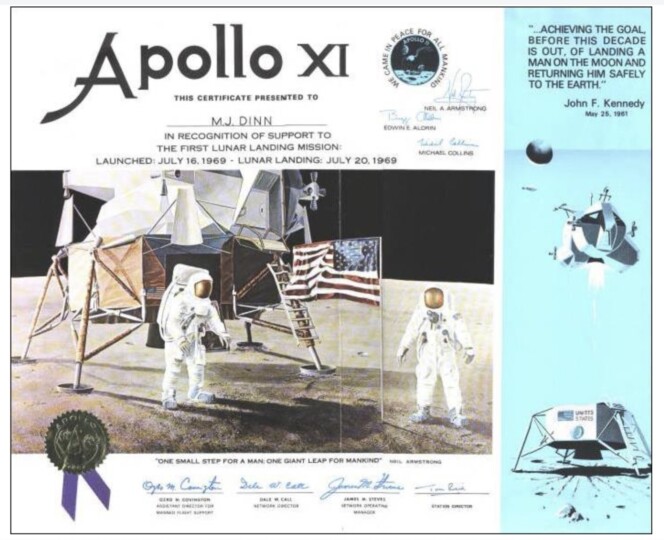
Certificate awarded to Mike Dinn in recognition of his service regarding the televisation of the moon landings. Images c/o Mike Dinn
College life
I never seemed to feel the cold then, as I threw myself into many of the activities available. This included being active in the Student Union which may have distracted me a little from my studies but taught me the importance of being involved with college life. I also followed Bradford Northern in those successful years and went on my first trip to London to watch the 1947 Cup Final. I didn’t realise I had an accent until I went there.
“I also had my last job in engineering in the UK at English Electric, Thornbury before leaving for what I thought would only be a three-year contract in Australia.
“In recent years, modern social media sites have been a boon to me, allowing correspondence with and contribution to many Bradford groups. So many of my fond memories, are thankfully kept alive via modern communications.”
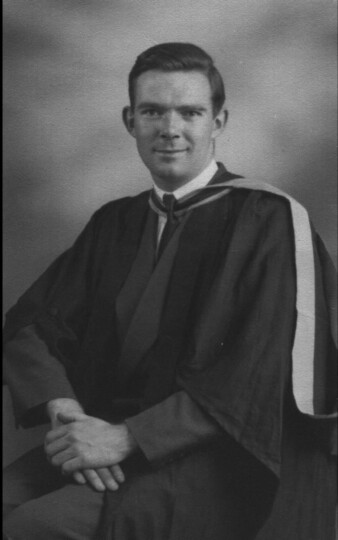
Mike Dinn pictured in 1955 after graduating from London University. Images c/o Mike Dinn
Deep space
In 1966, Mike became Deputy Director of Operations at NASA’s Deep Space tracking station in Canberra. A year later, he joined the Honeysuckle Creek station, which supported every Apollo mission from 7 to 13. It was Honeysuckle Creek that transmitted the first live television images of Neil Armstrong’s Moon landing in 1969, a moment watched by millions around the world. Mike and his team also played a vital role in maintaining communications during the tense return of Apollo 13.
Following Apollo, Mike helped design NASA’s 64-metre antenna at Tidbinbilla and later led support for the Voyager missions to Uranus and Neptune. As Director of the Canberra Deep Space Communication Complex, he oversaw major missions including Galileo and Magellan, before retiring in 1994.
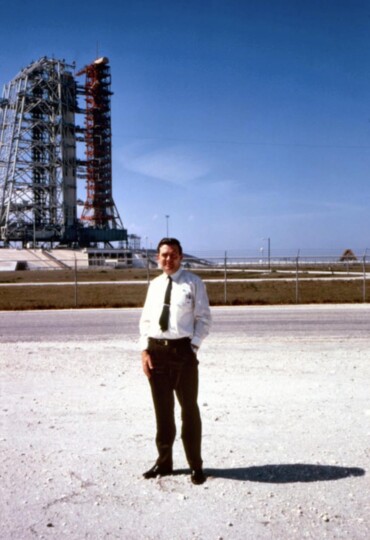
Mike Dinn at Cape Kennedy during a visit after the Apollo 12 launch in November 1969 – its launch support tower was still in place. Images c/o Mike Dinn
Bradford’s space centre
Now in his 90s and living in Australia, Mike’s legacy continues to inspire. His story resonates strongly with the University of Bradford’s own ambitions in space research and innovation. Through the Bradford-Renduchintala Centre for Space AI, the University is helping shape the future of space exploration – offering cutting-edge degrees in satellite technology, AI and data science, and contributing to global research in space systems and sustainability.