
Study to slow short-sightedness in young adults
The University of Bradford is spearheading a study into the progression of short-sightedness among young adults, aiming to tackle one of the fastest-growing global eye health challenges.
The research on short-sightedness, also known as myopia, among people aged in their 20s follows similar research into myopia among children.
Myopia is defined as a common eye condition where you cannot see objects far away clearly. It is usually corrected with glasses or contact lenses. A total of 50 per cent of the world’s population are predicted to be myopic by 2050, with 10 per cent of them having a high prescription over -6.00D.
Slowing down myopia progression
Professor Edward Mallen, Professor of Physiological Optics, School of Optometry and Vision Science at the University of Bradford, said: “Myopia management is the biggest growth area in research in optometry at the minute.
“Alongside myopia comes other potential eye health problems. It’s not just about the need for spectacles or contact lenses.
“Myopic eyes are vulnerable to things like macular degeneration and other conditions. Trying to control that is really important.
“It’s about slowing down myopia progression. We can correct myopia with spectacles and contact lenses, we’ve done that for a long time. But now we’ve got great products that can correct the vision and can slow down the rate of progression.”
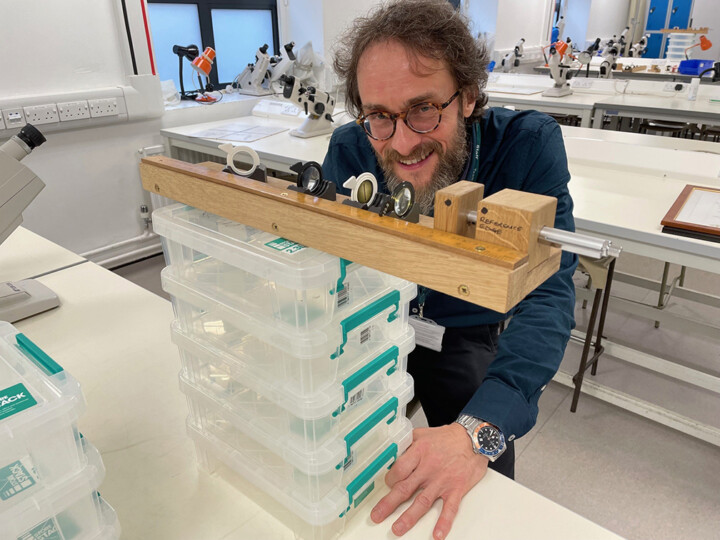
Professor Edward Mallen is carrying out a study on myopia in adults aged in their 20s. Images credit: University of Bradford
How the myopia study works
In collaboration with the University of Huddersfield, researchers at Bradford are investigating contact lenses worn by people in their 20s, to see if these products work to slow the progression of myopia in that age group.
Participants in the study, University of Bradford students and members of the public who have myopia, are fitted with either spectacles, or contact lens, intervention to correct their short-sightedness.
They are tracked over time to detect any potential changes in their sight, with researchers looking specifically at the strength of their prescription, and the axial length of the eye – the length of the eye from front to back – to see how that changes. Researchers are measuring the refraction (the error in how the eye’s cornea and lens bend light to focus it on the retina) and the length of the eye and gathering data over time.
Participants are seen every six months by researchers to gather data, which will ultimately lead to a research paper on their findings on myopia in people aged in their 20s.
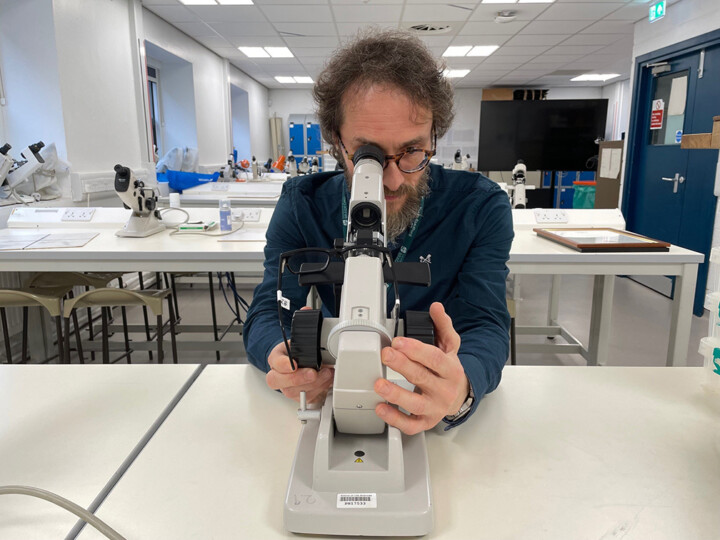
Professor Edward Mallen, Professor of Physiological Optics, School of Optometry and Vision Science at the University of Bradford. Images credit: University of Bradford
Life Fellowship
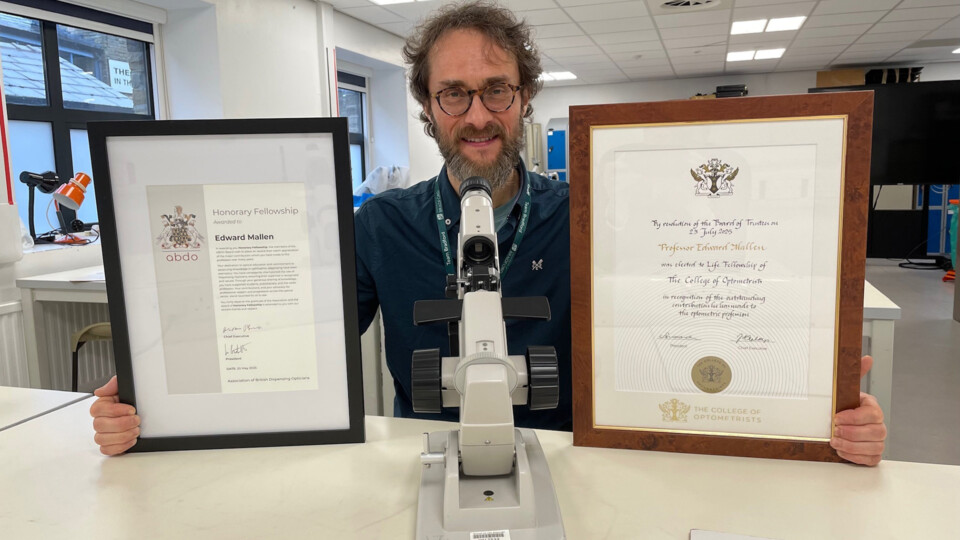
Professor Mallen was awarded the Life Fellowship of the College of Optometrists in November 2025.
The College of Optometrists recognises the outstanding achievements and contributions of individuals across the country working in eye health by awarding new Life and Honorary Fellowships.
Professor Mallen joined the University of Bradford as a lecturer in 2003, after studying for a PhD at Aston University and initially working in community optometry in the late 1990s.
He said: “The Life Fellowship is amazing, just a very proud moment. It means a lot.
“I don’t have A-levels. I left school at 16 and went to work in the theatre as a lighting technician.
“The strapline is I ran away from the theatre to become an optician.”
Professor Mallen was also made an Honorary Fellow of the Association of British Dispensing Opticians (ABDO) in May 2025; only five optometrists have been awarded both Life Fellowship of the College of Optometrists and Honorary Fellowship of ABDO.
The Myopia Management Clinic at the University of Bradford opened in 2017 in response to the increase in myopia found around the world, and the observed increase in myopia in children attending for sight tests locally. The Myopia Management Clinic is also open to new patients.
This research exemplifies the University of Bradford’s 2025-2035 strategy by advancing our reputation for world-class research and innovation while addressing a global health challenge predicted to affect half the population by 2050. By involving students in cutting-edge optometry studies, we put learners at the heart of our mission and create transformative experiences that widen access to knowledge.
The collaboration with the University of Huddersfield reflects Bradford’s commitment to partnerships and knowledge mobilisation, driving sustainable social and economic development locally and globally.